
When a driver reports a “rear-end noise,” the underlying issue may be in the differential carrier (gears and internal bearings), the axle shafts, or the wheel ends (hubs, seals, and wheel-end bearings). Correctly identifying the problem is essential because a wheel-end bearing failure can lead to overheating and structural damage in the wheel assembly. Meanwhile, a differential fault often involves gear mesh, bearing preload, or lubrication issues inside the housing.
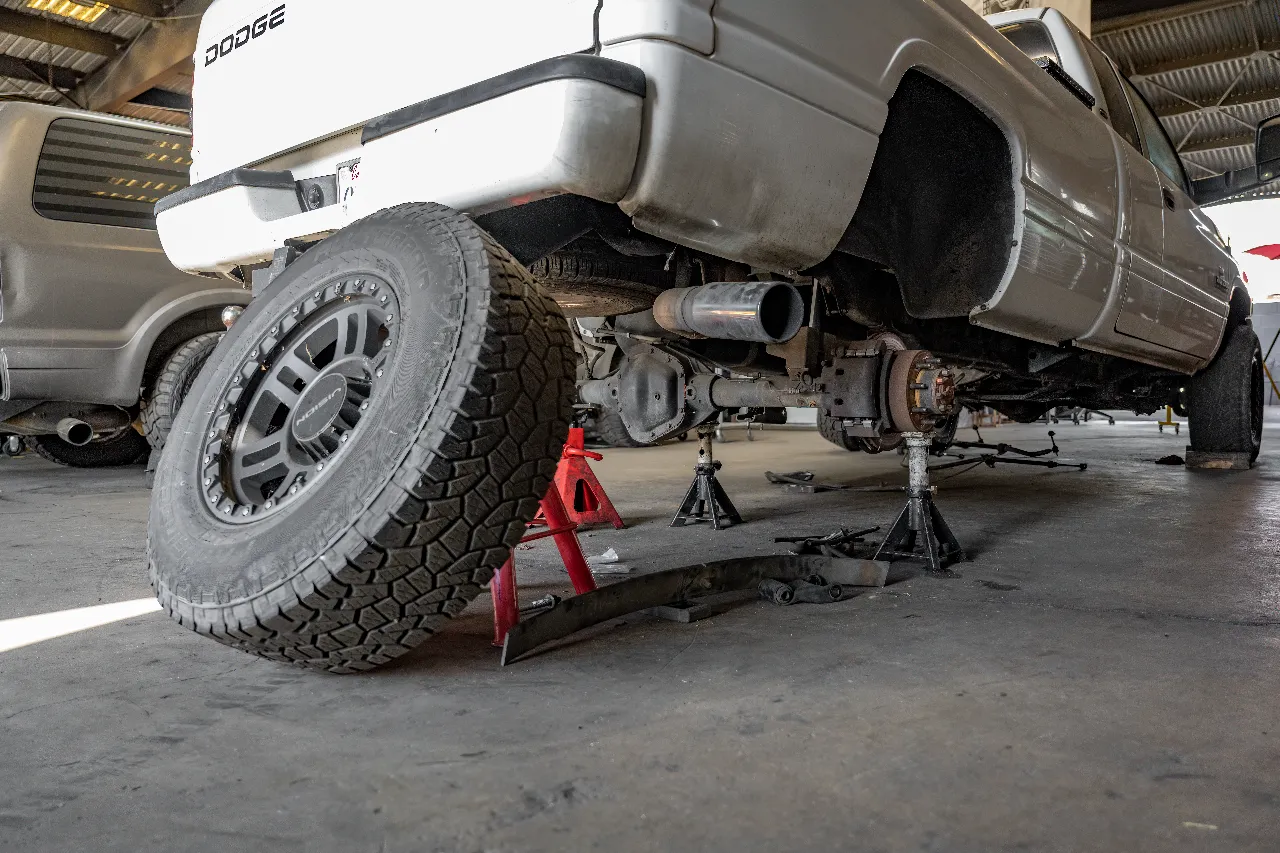
When a driver reports a “rear-end noise,” the underlying issue may be in the differential carrier (gears and internal bearings), the axle shafts, or the wheel ends (hubs, seals, and wheel-end bearings). Correctly identifying the problem is essential because a wheel-end bearing failure can lead to overheating and structural damage in the wheel assembly. Meanwhile, a differential fault often involves gear mesh, bearing preload, or lubrication issues inside the housing.
POWER FLOW AND COMPONENT ROLES
In heavy-duty driveline systems, the driveline transfers power from the engine through the transmission to the driven axles, with the driveshaft acting as the rotating link between the transmission and the differential.
The differential is a gear set that distributes power to both wheels in two directions (left and right), enabling one wheel to rotate at a different speed than the other during turns—an essential feature because the inside wheel covers a shorter distance than the outside wheel when cornering.
Axle shafts connect the differential to the wheel hub and spin with minimal friction, thanks to bearings and races that support rotation and reduce heat-producing friction.
Lubrication is essential to all of the above. In heavy-duty applications, “gear oil" typically describes the lubricant used in the differential housing; it is designed to withstand high pressure and high temperatures while minimizing friction and wear on gears and bearings.
DEFINING THE FAULT ZONES: DIFFERENTIAL VS. REAR AXLE/WHEEL ENDS
A practical diagnostic breakdown is as follows:
- Differential fault domains include the ring-and-pinion gearset, spider/side gears, carrier/pinion bearings, and setup variables such as backlash and pinion bearing preload, all of which are critical. Dana’s service guidance highlights that axle service requires careful attention to preload, backlash, and gear contact patterns after disassembly or overhaul.
- Rear axle/wheel-end fault domain: Axle shafts, hub seals (including axle seal leaks), and wheel-end bearings with associated components.
Meritor’s wheel-end service documentation clearly distinguishes this by describing wheel ends as assemblies that need periodic inspection and lubrication in traditional designs. It also states that rear-drive axle wheel bearings can be oil-lubricated through circulation from the differential carrier or housing to the hub and back.
This distinction is important for diagnosis: a lubrication or bearing problem at the wheel end might present as a speed-dependent rumble or heat at one hub. In contrast, an issue with differential gearing or setup is more often manifested as a load-sensitive whine (during acceleration versus coasting) or as debris in the housing lubricant.
SYMPTOM LOGIC THAT SEPARATES THE TWO
SPEED-DEPENDENT NOISE (VEHICLE SPEED, NOT ENGINE RPM)
A noise that increases with vehicle speed usually originates downstream of the transmission—typically the wheel ends or final-drive components—because these components rotate directly relative to road speed. Timken’s wheel hub bearing guidance notes that humming, rumbling, growling, and grinding during motion are common signs of wheel-end bearing issues, especially when a slight steering input changes their loudness.
Since axle shafts connect the differential to the wheel hubs, problems with the shaft or wheel-end may cause rear-end vibration or noise that depends on speed, even when engine RPM changes with gear selection.
LOAD-SENSITIVE NOISE (ACCELERATION VS. COAST)
A key difference between rear axle and differential issues is whether the noise varies under applied torque versus during deceleration or coasting. Differential gear contact and bearing support conditions vary with load direction, which is why service literature emphasizes the importance of proper preload, backlash, and contact patterns for proper gear mesh and durability.
In contrast, a wheel-end bearing with mechanical damage may produce a steadier rumble that largely tracks speed, with variations more closely related to steering load transfer than to throttle use. Timken specifically mentions that grinding can happen during turning or when a load shifts, consistent with wheel-end damage patterns.
TURN-SENSITIVE NOISE (LEFT VS. RIGHT)
During cornering, the differential allows the two wheels on a drive axle to rotate at different speeds; this is the main reason it exists in road vehicles. Although turning also affects bearing loading at the wheel ends, a turn-sensitive rumble often indicates a wheel-end bearing issue.
Bearing-related rumble can increase with minor steering input, and it often indicates that the side opposite the rumbling may be faulty, reflecting load transfer during cornering.
CLUNKING ON SHIFT OR ON/OFF THROTTLE
A “clunk” during direction changes or when transitioning from accelerating to coasting can be related to the driveline (U-joints/CV joints) or may indicate excessive backlash in differential gears; Timken’s guidance clearly states this symptom is not usually linked to bearings.
Accordingly, if the complaint mainly involves a clunk during load transition (without ongoing hub rumble or heat), differential lash or driveline connection play should stay on the list.
LUBRICANT AND DEBRIS: THE MOST RELIABLE “HARD EVIDENCE”
Because gear oil lubricates the differential housing's gears and bearings under high load, its condition directly indicates internal health: contamination, low levels, or metal debris can quickly speed up wear.
The wheel-end inspection procedure for oil-lubricated hubs involves inserting a magnet through the hubcap fill plug into the lubricant and checking for metal pickup. This objective test helps quickly evaluate the condition when noise complaints are reported.
If metal is detected, it does not automatically determine whether the source is the differential or the wheel end; however, it signals active wear and warrants immediate escalation to controlled disassembly or further inspection, rather than continuing operation.
WHEEL-END BEARING FAILURE: WHY IT IS TREATED AS URGENT
From a safety and risk standpoint, wheel-end bearing failures demand immediate action. The handbook highlights overheating as a key symptom, noting that increased friction can cause the wheel assembly to overheat and produce smoke, and warns that a blown bearing can weaken the wheel's structural integrity and lead to wheel separation.
If loose bearings (“chucking”) or other serious wheel-end issues are identified during inspection, the vehicle should be taken out of service until repaired.
When a complaint involves hub heat, smoke, grinding, or confirmed looseness, the initial assumption should be that the wheel-end bearing or seal integrity takes priority until proven otherwise.
DIFFERENTIAL SETUP VARIABLES THAT DRIVE FAILURE AND NOISE
Differential noise depends not only on worn parts but also on assembly setup parameters.
Dana’s ring-and-pinion service document states that Dana drive axles require adjusting the ring gear and pinion tooth contact during an overhaul or whenever the axle is disassembled, explicitly linking the tooth contact pattern to the relative positions of the ring gear and pinion. It further instructs that after completing pinion bearing preload and backlash adjustments, the tooth contact pattern must be checked and corrected if necessary.
This guidance is essential for diagnostics: a noticeable whine that varies with load may indicate an underlying contact pattern or backlash, in addition to (or instead of) component wear.
Spicer’s technical overview of axle rebuilding also emphasizes the same professional focus areas—identifying shim/crush sleeve configuration, setting bearing preload, measuring backlash, and adjusting based on gear pattern—reflecting industry-standard practice for final-drive service.
A FORMAL DECISION TREE FOR OPERATORS AND FLEETS
The following logic can help fleets and owner-operators accurately describe symptoms before contacting a shop (including Langford Tire Service in Evans, GA), while still respecting safety boundaries.
STEP 1: IDENTIFY THE TRIGGER CONDITION
- Primarily speed-dependent rumble or growl, worse with slight steering input: suspect wheel-end bearings.
- Primarily load-dependent whine or howl (acceleration versus coast changes): suspect differential gear mesh or support issues and consider backlash, preload, and tooth contact pattern as potential causes.
- Primarily a clunk at shift or load transition: suspect driveline joints or differential lash; do not automatically suspect bearings.
STEP 2: CHECK FOR IMMEDIATE STOP CONDITIONS
Stop conditions are signs of impending wheel-end failure: severe overheating, smoke, or grinding indicative of metal-on-metal contact. The handbook’s description of bearing failure clearly identifies these as key indicators and associates failure with the loss of wheel assembly integrity.
Meritor’s guidance to take a vehicle out of service when looseness (“chucking”) or severe wheel-end conditions are observed reinforces the same safety threshold.
STEP 3: DOCUMENT LUBRICANT EVIDENCE
When safe and appropriate, note whether there is evidence of lubricant loss, such as wet hubs or housing. Gear oil, which is the lubricant in the differential housing, protects gears and bearings under high pressure and temperature. Therefore, fluid loss can accelerate wear and generate noise.
For oil-lubricated hubs, Meritor’s method of checking for metal with a magnet through the hubcap fill plug is an example of a controlled, objective check that supports triage.
WHAT A PROFESSIONAL SHOP WILL DO TO CONFIRM THE FAILURE LOCATION
A formal diagnosis in a diesel repair setting typically involves road testing combined with mechanical inspection to identify whether the issue is in the wheel ends, axle shafts, or the differential.
Meritor’s “basic inspection” guidance for wheel ends includes lifting and supporting the axle, rotating the wheel, and listening or feeling for rough bearing operation or vibration; it also involves checking for metal in oil-lubricated hubs and inspecting for looseness (“chucking”).
If these wheel-end checks are negative, the diagnostic focus usually shifts to the differential: checking lubricant condition, looking for metallic debris, and (if disassembly is performed) confirming pinion bearing preload, backlash, and tooth contact pattern in line with Dana’s service guidance.
Additionally, Meritor’s documentation explains that rear drive axle wheel bearings can be lubricated with oil circulated from the differential carrier or housing to the hub and back. This indicates that differential lubricant management and wheel-end health are mechanically coupled; a problem in the lubrication pathways can therefore affect multiple components of the “rear end” simultaneously.
PREVENTION: THE MOST COST-EFFECTIVE DIFFERENTIATOR
Preventive maintenance in heavy-truck contexts is a systematic approach to inspection and servicing designed to prevent breakdowns and extend operational life, rather than waiting for failures to happen. Meritor’s wheel-end guidance supports this principle, stating that conventional wheel ends (hub, seal, lubricant, and bearings installed as separate components) require regular inspection and lubrication to maintain performance.
Practically, a rear-end reliability prevention program should include:
- Regular visual inspection of hubs and axle housings for leaks is necessary because lubricant loss reduces gear and bearing protection.
- Conduct routine wheel-end inspections for roughness, vibration, looseness, and metal contamination in oil-lubricated hubs, in accordance with Meritor inspection procedures.
- Controlled service procedures after axle disassembly to restore backlash, pinion bearing preload, and tooth contact pattern to specification, because improper contact patterns can cause noise and premature wear.
CONCLUSION
To distinguish between rear axle and differential problems, a systematic approach is more reliable than guesswork: determine whether the symptom depends on speed, load, or turns; identify critical wheel-end risk signs (heat, smoke, grinding, looseness); and verify lubricant condition and metal contamination as objective evidence. These methods follow published guidance on differential operation, lubrication, wheel-end inspection, and gear setup basics.
If you are operating in or near Evans, GA, and notice hub overheating, grinding, or looseness—or suspect differential gear noise under load—contact Langford Tire Service to schedule a formal driveline inspection. Use the symptom logic above to describe when the noise occurs (speed, load, turning) so the diagnostic process can proceed efficiently and safely.
News & Articles
Read About The Latest in Industry
Here, you'll find regular articles covering a wide range of topics related to diesel repair, maintenance, and troubleshooting.
.webp)
.webp)
.webp)
.webp)
.jpg)


Don't Just Take Our Word For It.

Contact Langford Tire Service
Based out of Evans, Georgia, Langford Tire Service brings our mobile diesel repair and maintenance services to you throughout the Augusta Metropolitan Area.